Cocoa · 7 min read ·
Dutch-Process vs Natural Cocoa Powder: What's the Difference?
Dutch-process cocoa is cocoa powder treated with an alkali, usually potassium carbonate, to neutralize its natural acidity. That raises the pH to around 7 or higher, darkens the color and mellows the flavor. Natural cocoa stays acidic, at about pH 5 to 6, so it reacts with baking soda; Dutch-process cocoa does not.
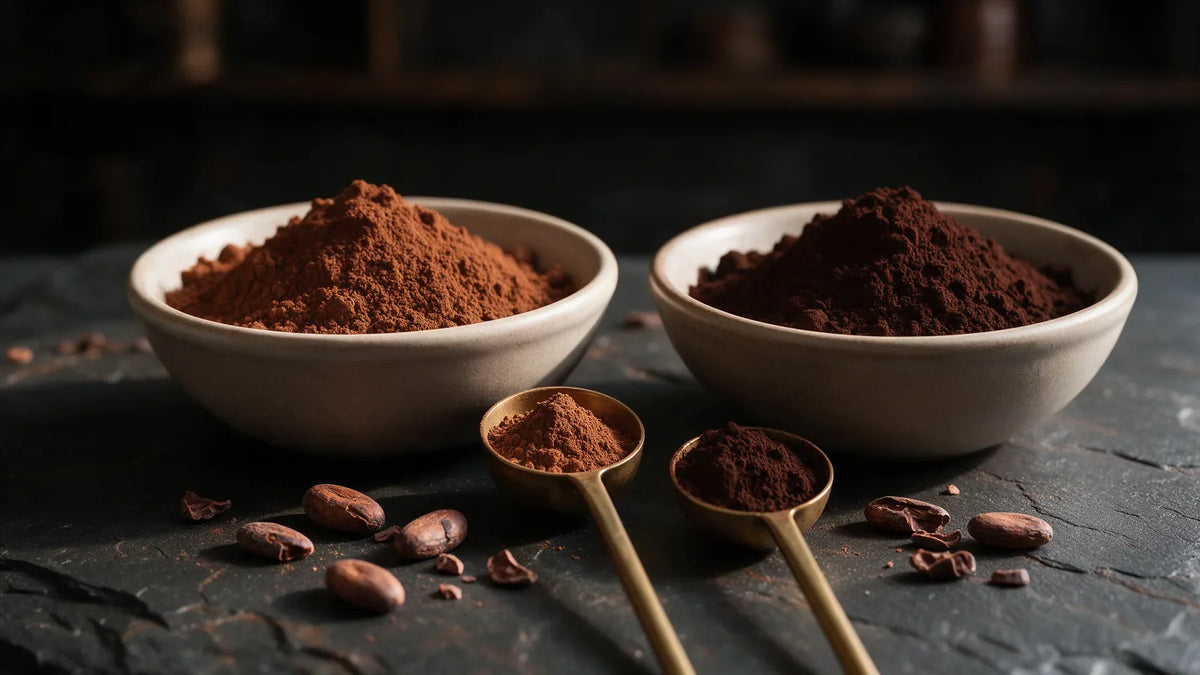
Dutch-process cocoa, also called alkalized or Dutched cocoa, is cocoa powder treated with an alkaline solution during processing. The treatment neutralizes the acidity cocoa naturally carries, which gives a darker color, a smoother and less sharp flavor, and easier dispersion in liquids. Natural cocoa skips that step and stays acidic, which changes how it behaves with baking soda.
What is Dutch-process cocoa?
All cocoa powder starts the same way. Cacao beans are fermented, dried, roasted and cracked into nibs, and the nibs are ground into cocoa mass (also called cocoa liquor). A press squeezes out much of the cocoa butter, leaving a dry cake that is milled into powder. If the line between cacao and cocoa feels fuzzy, our guide to cacao vs cocoa walks through it.
For Dutch-process cocoa, the nibs, the cocoa mass or the powder are treated with an alkali and then dried. US federal rules list the permitted alkali ingredients for cacao products, including potassium and sodium carbonates, and require the label to say "Processed with alkali" or name the alkali used. The process takes its name from the Netherlands, where it was developed in the 19th century. Manufacturers control how far they push it: a light alkalization lands close to neutral, and a heavy one produces the very dark, almost black cocoa used to color sandwich cookies.
What alkalization changes
- pH. Natural cocoa is acidic, around pH 5 to 6. Alkalized cocoa typically sits between roughly 6.8 and 8, depending on how strongly it was treated.
- Color. The powder shifts from a light, reddish brown to a deep brown, and heavily alkalized powders go nearly black.
- Flavor. The sharp, fruity, slightly astringent notes soften into a rounder, earthier chocolate flavor.
- Behavior in liquid. Alkalized cocoa disperses more easily in milk and water, which is why it is the usual choice for drinks, ice cream and puddings.
Laboratory work backs up the kitchen experience: a 2024 peer-reviewed survey of cocoa powders sold in Europe found that alkalization raised the pH of the powders and gave them a darker, more browned color.
Dutch cocoa vs regular cocoa: comparison table
In the United States, "regular cocoa" usually means natural unsweetened cocoa. Here is how the two compare.
| Property | Natural cocoa (non-alkalized) | Dutch-process cocoa (alkalized) |
|---|---|---|
| pH | About 5 to 6 (acidic) | About 6.8 to 8 (neutral to mildly alkaline) |
| Color | Light, reddish brown | Medium to very dark brown |
| Flavor | Sharp, fruity, more astringent | Mellow, round, earthy |
| Behavior in liquids | Tends to clump and settle | Disperses more easily |
| Leavening behavior | Reacts with baking soda to release carbon dioxide | Does not react with baking soda; pairs with baking powder |
| Label wording | "Natural" or "unsweetened cocoa", cocoa as the only ingredient | "Dutch-process", "alkalized" or "processed with alkali" |
| Best for | Recipes written for natural cocoa plus baking soda | Drinks, ice cream, sauces, puddings, frostings, fudgy brownies |
Natural (non-alkalized) cocoa, in brief
Natural cocoa, sometimes labeled non-alkalized cocoa, is roasted cocoa solids ground to a powder with nothing added. Its acidity is useful in baking: when it meets baking soda in a batter, the two react and release carbon dioxide, which helps a cake rise. Many classic American cake and cookie recipes are built around that reaction.
Leavening: why baking soda and baking powder matter
This is where the two cocoas stop being interchangeable. Baking soda (sodium bicarbonate) is a base. On its own it cannot lift a batter; it needs an acid to react with, such as natural cocoa, buttermilk, yogurt, brown sugar or lemon juice. Baking powder already contains its own acid, so it works whatever kind of cocoa is in the bowl. As Iowa State University Extension notes, recipes built on Dutch-process cocoa generally use baking powder for exactly this reason.
- A recipe that calls for natural cocoa and only baking soda is counting on the cocoa's acid.
- A recipe that calls for Dutch-process cocoa usually relies on baking powder, because the cocoa contributes almost no acid.
Can you substitute Dutch-process for natural cocoa?
Often, yes. The leavening in the recipe decides.
Swap freely
- Recipes with no chemical leavening: hot chocolate, sauces, puddings, ganache, frostings, ice cream and most fudgy brownies.
- Recipes leavened mainly with baking powder, especially when they also include other acidic ingredients such as buttermilk or yogurt.
Swap with care
If a cake or cookie recipe calls for natural cocoa with baking soda as its only leavening, swapping in Dutch-process cocoa removes the acid the soda needs. The result can be dense and flat, with a slightly soapy or metallic taste from unreacted soda. Two common fixes:
- Add an acid with the Dutch-process cocoa. A widely used kitchen rule is 1/8 teaspoon cream of tartar, lemon juice or white vinegar for every 3 tablespoons of Dutch-process cocoa.
- Replace some or all of the baking soda with baking powder. Baking powder is roughly a third as strong, so 1/4 teaspoon baking soda becomes about 3/4 teaspoon baking powder.
Going the other way
Putting natural cocoa into a recipe built for Dutch-process cocoa and baking powder usually still rises, but the batter is more acidic: expect a lighter color and a sharper flavor. A pinch of baking soda (about 1/8 teaspoon per 3 tablespoons of cocoa) brings it back toward neutral.
How to tell which cocoa powder you have
- Read the label. Look for "Dutch-process", "Dutched", "alkalized" or "processed with alkali". If the ingredient list names potassium carbonate or another alkali after cocoa, it is alkalized. If cocoa is the only ingredient and none of those words appear, it is natural.
- Look at the color. Natural cocoa is lighter and leans reddish. Dutch-process cocoa is a deeper, cooler brown.
- Taste a pinch. Natural cocoa is sharper and more acidic on the tongue. Dutch-process cocoa tastes smoother and rounder.
- Test the pH. Stir a teaspoon of cocoa into a few tablespoons of water and dip a pH strip. A reading of 5 to 6 points to natural cocoa; around 7 or higher points to Dutch-process.
Dutch-processed cocoa powder for baking: when to choose it
Reach for Dutch-process cocoa when you want deep color and a smooth, rounded chocolate flavor, and when the recipe relies on baking powder or has no leavening at all. It shines in:
- Hot chocolate and drink mixes, where easy dispersion matters. Try our hot chocolate with cocoa powder.
- Fudgy brownies, which get their texture from eggs, sugar and fat rather than from a big chemical rise. See our fudgy cocoa brownies.
- Chocolate sauces, puddings, ice cream bases and frostings.
- European-style cakes and cookies written for alkalized cocoa.
Natural cocoa remains the right call for recipes, often older American ones, that pair it with baking soda alone.
Fat content: what 10–12% means on a cocoa label
The fat in cocoa powder is the cocoa butter left behind after pressing. Under US federal standards, cocoa must contain between 10% and 22% fat; powder with 22% or more is sold as breakfast cocoa, and powder below 10% is low-fat cocoa. A 10–12% cocoa is the standard baking style: it measures predictably, blends easily into dry ingredients and gives recipes a clean chocolate flavor. Higher-fat cocoas feel richer in the mouth, but the extra fat can change texture in recipes developed for standard cocoa.
Franceschi Cocoa Powder Alkalized 10–12%
Our Cocoa Powder Alkalized 10–12% is a Dutch-process cocoa alkalized with potassium carbonate. Its pH of 6.8 to 7.3 places it right around neutral, and it has 10–12% fat. The powder is fine and free-flowing (99% minimum passes through a 200 mesh, 75 µm sieve), with a deep dark-brown color and a smooth, characteristic cacao flavor with mild bitterness. It is a product of Peru, and the ingredient list is simply cocoa powder and potassium carbonate. You will find it in our cocoa powder collection.
Because its pH sits near neutral, treat it like any Dutch-process cocoa: use it freely in drinks, brownies, sauces, frostings and baking powder recipes, and add a little acid, as described above, when a recipe was written for natural cocoa and baking soda.
If cocoa is a weekly ingredient in your kitchen, keep a 2 lb (907 g) resealable bag of Franceschi Cocoa Powder Alkalized 10–12% on the shelf and bake with consistent color and flavor from batch to batch.
Frequently asked questions
Is Dutch-process cocoa the same as unsweetened cocoa?
Not necessarily. Unsweetened describes sugar, not processing, and both natural and Dutch-process cocoa are sold unsweetened. Dutch-process refers to the alkali treatment that neutralizes acidity, darkens the color and mellows the flavor. Check the package for words such as Dutch-process, alkalized or processed with alkali to know which unsweetened cocoa you are holding.
Can I use Dutch-process cocoa instead of regular cocoa?
Yes in drinks, sauces, frostings, brownies and recipes leavened with baking powder. Take care in cakes that rely on natural cocoa and baking soda alone, because Dutch-process cocoa does not supply the acid the soda needs. In that case add about 1/8 teaspoon cream of tartar or lemon juice per 3 tablespoons of cocoa, or replace some of the soda with baking powder.
What does processed with alkali mean on cocoa?
It means the cocoa was treated with an alkaline ingredient, most often potassium carbonate, to raise its pH. In the United States it is the required label wording for Dutch-process cocoa. The treatment makes the powder darker, smoother tasting and easier to disperse in liquids, and it removes most of the natural acidity that reacts with baking soda.
Is Dutch cocoa better for baking?
It is better for some recipes, not all. Dutch-process cocoa gives deeper color and a rounder flavor in brownies, European-style cakes and anything leavened with baking powder. Natural cocoa suits recipes built on baking soda, because its acidity drives the rise. Use the cocoa the recipe names unless you adjust the leavening to match.
Is black cocoa the same as Dutch-process cocoa?
Black cocoa is a very heavily alkalized form of Dutch-process cocoa. The stronger treatment pushes its color close to black and gives it a very mild, almost flat chocolate flavor. Bakers usually blend a small amount with regular Dutch-process cocoa for dramatic color, since on its own it can taste one-dimensional.